Publications
Publications
Filter by
A novel scheme for relay cooperation in interweave cognitive radio systems
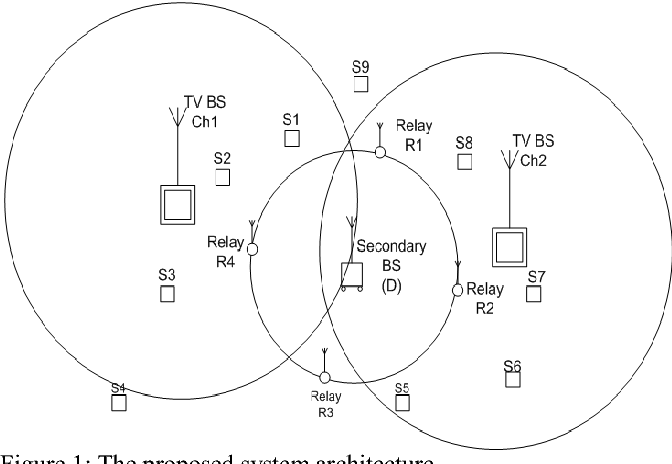
In this paper, we investigate the benefits of using cooperative relays in interweave (opportunistic) cognitive radio systems. A novel distributed space frequency (DSF) code for relay cooperation is presented. The code is designed to be a multi-user multi-OFDM channels code. It achieves a cooperative diversity gain of order NL for all users, where N is the number of relays and L is the number of
3D/TSV enabling technologies for SoC/NoC: Modeling and design challenges
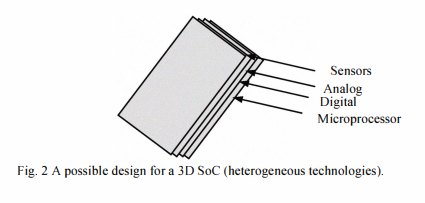
According to the International Technology Roadmap for Semiconductors (ITRS), the traditional scaling will no longer meet the performance and integration requirements of systems-on-chip (SoC) in the long term. Therefore, new I/O and packaging paradigms are needed. Three-dimensional integration is a promising alternative option to traditional 2D planar chips. 3D integration is mainly restricted by
SplitPro: A tool to overcome systemC scheduling inefficiencies
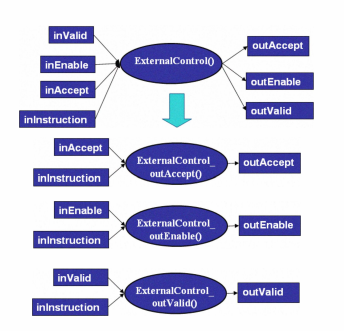
SplitPro is a tool that processes the code of large SystemC modules and splits them into two or more smaller ones without affecting functionality. The purpose of this process splitting is to overcome some inherent inefficiencies of the SystemC 2.1 scheduler, such as unnecessary process wake-up calls, and unnecessary evaluation of portions of code that do not change the output of the system at the
Methodology for analyzing case studies
Case studies provide the basis for empirical grounding of management theory or management principles. But there needs to be a systematic methodology for constructing case histories so that theory and principles can be compared to case reality. I propose such a methodology and illustrate the use of the methodology in two famous business cases - the origin of Cisco Systems and the bankruptcy of
Impact of systolic and diastolic deformation indexes assessed by strain-encoded imaging to predict persistent severe myocardial dysfunction in patients after acute myocardial infarction at follow-up
Objectives This study evaluated the value of systolic and diastolic deformation indexes determined by strain-encoded imaging to predict persistent severe dysfunction at follow-up in patients after reperfused acute myocardial infarction (AMI) in comparison with late gadolinium enhancement (LGE). Background Animal studies suggest that regional diastolic function provides information about myocardial
Quantitative myocardial blush grade for the detection of cardiac allograft vasculopathy
Background: Cardiac allograft vasculopathy (CAV) progressively compromises microvascular perfusion and function in heart transplantation (HTx)-recipients. The aim of our study was to investigate the ability of quantitative myocardial blush grade (MBG) to detect CAV. Methods: In consecutive HTx-recipients (n = 72) who underwent surveillance cardiac catheterization, MBG was assessed visually and
Price Earnings Multiples as Forecasters of Short Term Stock Returns in Egypt
The study examines determinants of price earnings (PE) multiples and their ability to forecast short term returns in the Egyptian stock market during the period from 2002 to 2007. Three factors were tested for their ability to determine the PE multiples. The three variables are growth, payout and return on equity (ROE) in the period from 2002 to 2005. Only Payout and ROE were found to be
FPGA implementation of a configurable viterbi decoder for software radio receiver
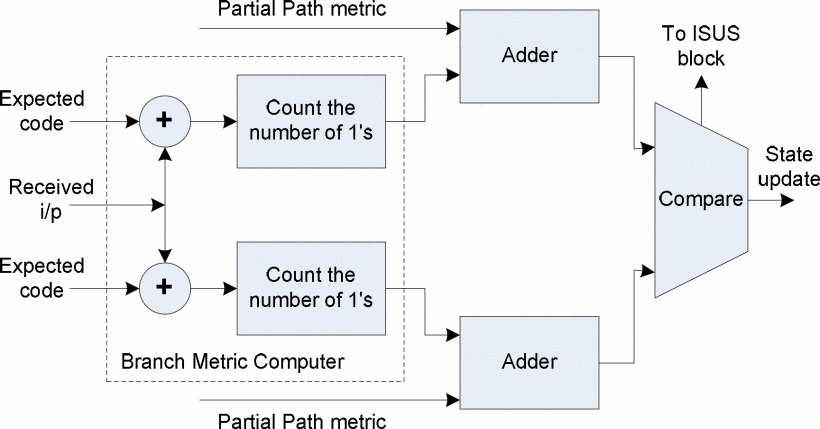
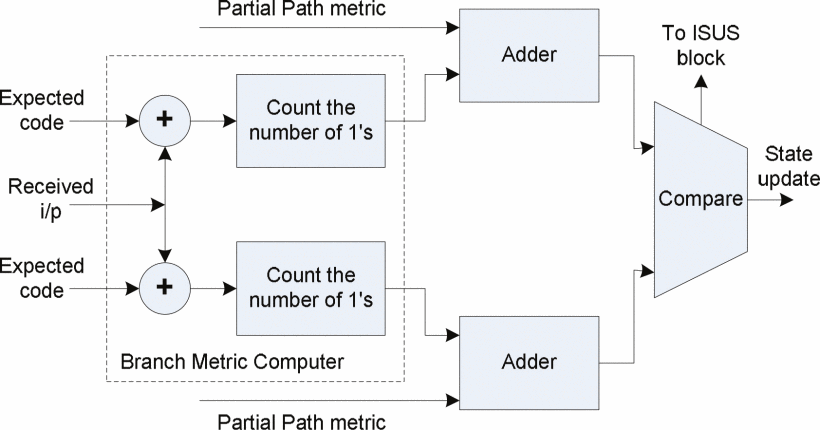
Convolutional codes are one of the Forward Error Correction (FEC) codes that are used in every robust digital communication system. Viterbi algorithm is employed in wireless communications to decode the convolutional codes. Such decoders are complex and dissipate large amount of power. Software Defined Radio (SDR) is realized using highly configurable hardware platforms. Field Programmable Gate
FPGA implementation of a reconfigurable Viterbi decoder for WiMAX receiver
Field Programmable Gate Array technology (FPGA) is a highly configurable option for implementing many sophisticated signal processing tasks in Software Defined Radios (SDRs). Those types of radios are realized using highly configurable hardware platforms. Convolutional codes are used in every robust digital communication system and Viterbi algorithm is employed in wireless communications to decode
ARQ secrecy: From theory to practice
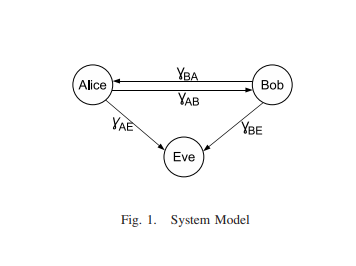
Inspired by our earlier work on Automatic Repeat reQuest (ARQ) secrecy, we propose a simple, yet efficient, security overlay protocol to existing 802.11 networks. Our work targets networks secured by theWired Equivalent Privacy (WEP) protocol because of its widespread use and vulnerability to a multitude of security threats. By exploiting the existing ARQ protocol in the 802.11 standard, our