Publications
Publications
Filter by
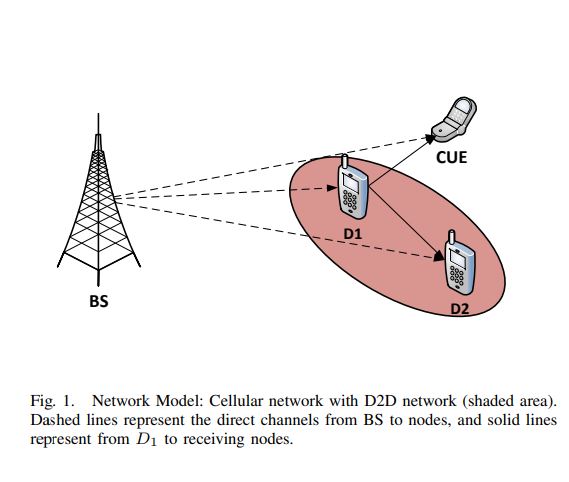
Cooperative D2D communication in downlink cellular networks with energy harvesting capability
Device-to-Device (D2D) communications have been highlighted as one of the promising solutions to enhance spectrum utilization of LTE-Advanced networks. In this paper, we consider a D2D transmitter cooperating with a cellular network by acting as a relay to serve one of the cellular users. We consider the case in which the D2D transmitter is equipped with an energy harvesting capability. We
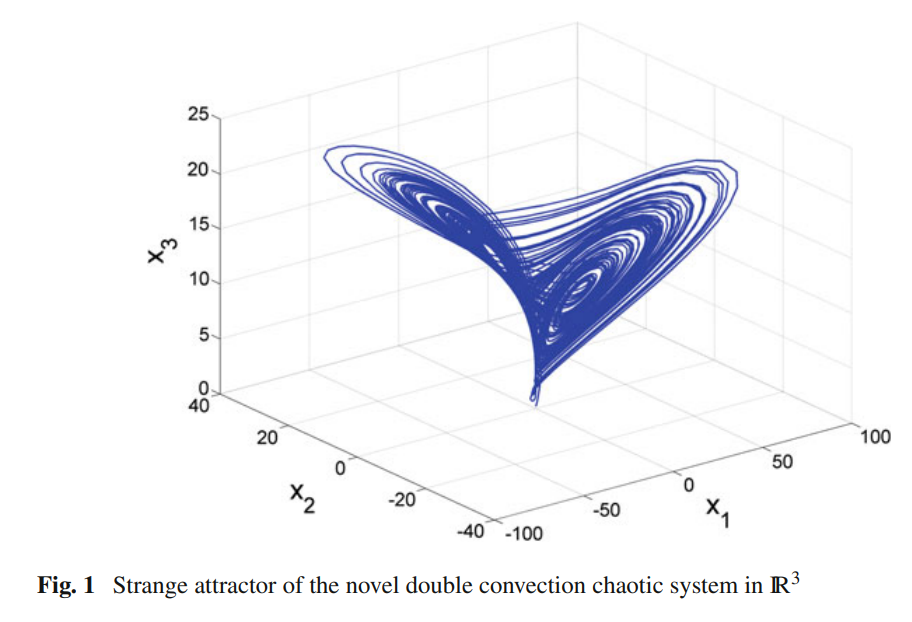
Adaptive control of a novel nonlinear double convection chaotic system
This researchwork describes a six-term novel nonlinear double convection chaotic system with two nonlinearities. First, this work presents the 3-D dynamics of the novel nonlinear double convection chaotic system and depicts the phase portraits of the system. Our novel nonlinear double convection chaotic system is obtained by modifying the dynamics of the Rucklidge chaotic system (1992). Next, the
Adaptive control of a novel nonlinear double convection chaotic system
This research work describes a six-term novel nonlinear double convection chaotic system with two nonlinearities. First, this work presents the 3-D dynamics of the novel nonlinear double convection chaotic system and depicts the phase portraits of the system. Our novel nonlinear double convection chaotic system is obtained by modifying the dynamics of the Rucklidge chaotic system (1992). Next, the
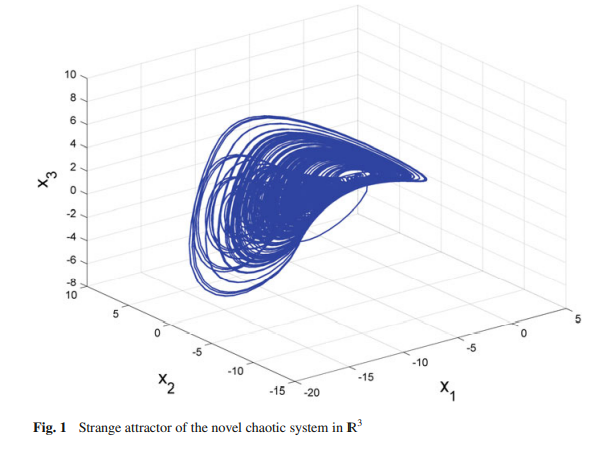
An eight-term 3-D novel chaotic system with three quadratic nonlinearities, its adaptive feedback control and synchronization
This research work describes an eight-term 3-D novel polynomial chaotic system consisting of three quadratic nonlinearities. First, this work presents the 3-D dynamics of the novel chaotic system and depicts the phase portraits of the system. Next, the qualitative properties of the novel chaotic system are discussed in detail. The novel chaotic system has four equilibrium points. We show that two
An eight-term 3-D novel chaotic system with three quadratic nonlinearities, its adaptive feedback control and synchronization
This research work describes an eight-term 3-D novel polynomial chaotic system consisting of three quadratic nonlinearities. First, this work presents the 3-D dynamics of the novel chaotic system and depicts the phase portraits of the system. Next, the qualitative properties of the novel chaotic system are discussed in detail. The novel chaotic system has four equilibrium points. We show that two
Generalized smooth transition map between tent and logistic maps
There is a continuous demand on novel chaotic generators to be employed in various modeling and pseudo-random number generation applications. This paper proposes a new chaotic map which is a general form for one-dimensional discrete-time maps employing the power function with the tent and logistic maps as special cases. The proposed map uses extra parameters to provide responses that fit multiple
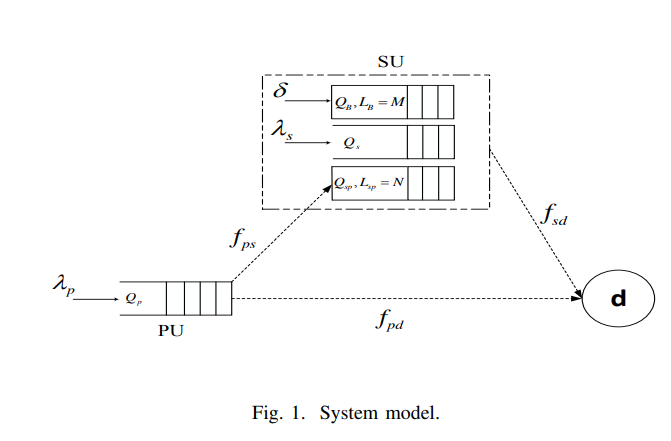
On the role of finite queues in cooperative cognitive radio networks with energy harvesting
This paper studies the problem of cooperative communications in cognitive radio networks where the secondary user is equipped with finite length relaying queue as well as finite length battery queue. The major hurdle towards fully characterizing the stable throughput region stems from the sheer complexity associated with solving the two-dimensional Markov Chain (MC) model for both finite queues
Degrees of Freedom for the MIMO Multi-Way Relay Channel with Common and Private Messages
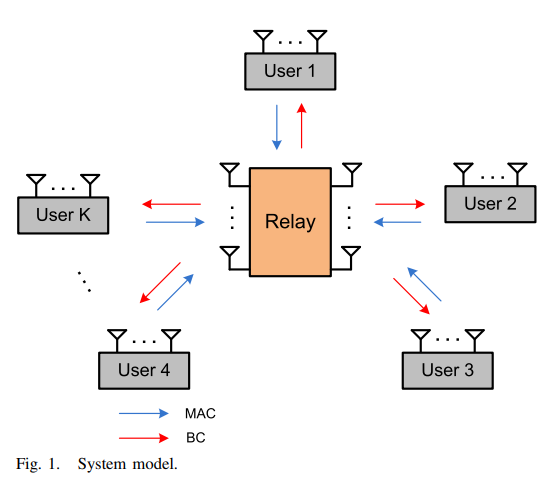
In this paper, we study the general multiple input multiple output (MIMO) multi-way relay channel, i.e., MIMO Y channel, with common and private messages. In this channel, K users exchange messages through a common relay. Each user transmits a private message to each user in addition to a common message to all the other users. The i th user and the relay are equipped with Mi and N antennas

Chaos synchronisation of continuous systems via scalar signal
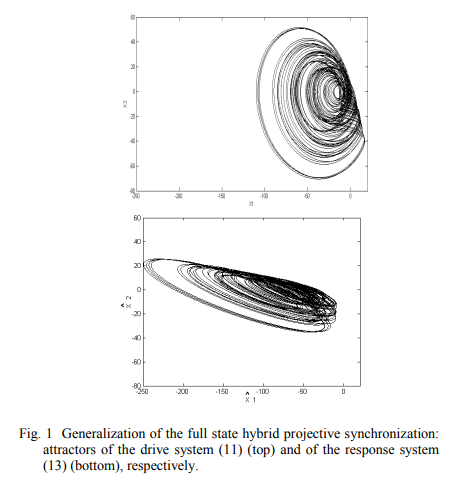
By analyzing the issue of chaos synchronization in the literature, it can be noticed the lack of a general approach, which would enable any type of synchronization to be achieved. Similarly, there is the lack of a unified method for synchronizing both continuous-time and discrete-time systems via a scalar signal. This paper and the companion one [1] aim to bridge these two gaps by presenting a