
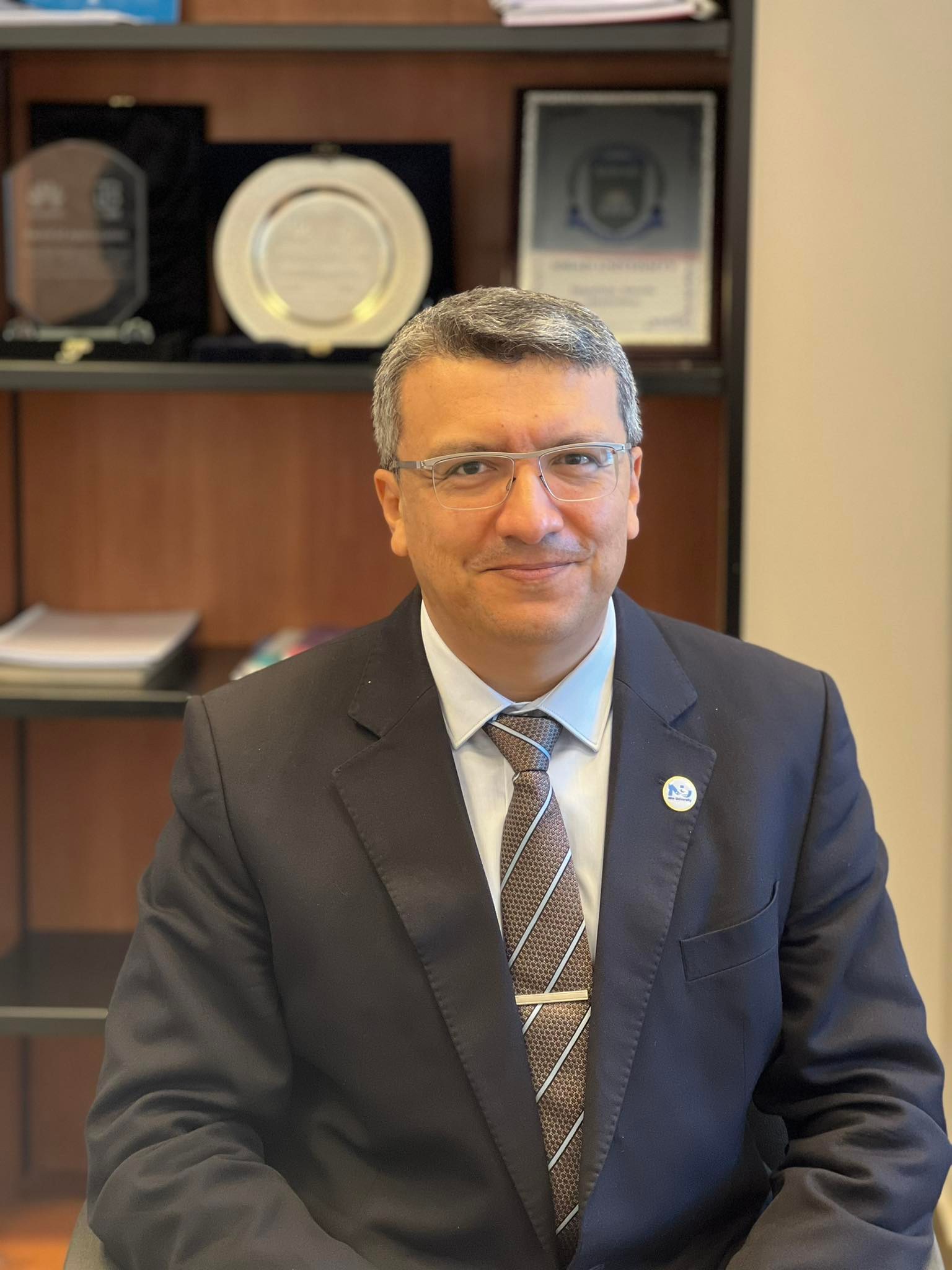
Prof. Ahmed Hazem El-Mahdy
Acting Vice President for Research
Dr. El-Mahdy is a full professor and the Dean of the School of Information Technology and Computer Science (ITCS) at Nile University; he was the Computer Science and Engineering department chair, and co-founder at the Egypt-Japan University of Science and Technology (E-JUST); and is on leave from the Computer and Systems Engineering Department at Alexandria University. He studied for a B.Sc. (1995) and an M.Sc. (1998) at Alexandria University.
He obtained his Ph.D. from Manchester University, UK (2001), then worked as a temporary lecturer and a research associate at the APT group, contributing to parallel runtime systems. He was also a visiting scientist at IBM's CAS, Cairo, where he was the first inventor of many US patents and an IBM Cell experts worldwide team member. He also visited the ALF group at Inria, Rennes, France, contributing to parallelising compilers and obfuscation. He was also invited to present his work at the Institute of Statistical Mathematics, Waseda, and Meisei University, Japan, on performance modelling and secure computation.
He has founded the Parallel Computing Lab at E-JUST and constructed many open-source cloud systems, with numerous funded research grants from IBM, Amazon, ITIDA, STDF, and ASRT in the intelligent transportation system, embedded compilers, high-performance GPU acceleration, high-performance computation on the cloud, and quantum computing engineering. Prof El-Mahdy also visited MIT's Media lab participating in D4D international competition. He is a senior member of the ACM and IEEE; and a full member of the Sigma Xi honour society. He is also a TPC member of ICCD, ARCS, and Supercomputing conferences. He co-founded a startup company whose idea won first prize at MIT Arab Startup Competition in 2017. He also established a CoderDojo with Bibliotheca Alexandrina as a volunteer to teach programming to kids. He also led the e-learning centre at Alexandria University.
Nile University Research Profile
Nile University (NU) is a world-class research-based learning institution committed to excellence in Education and Research.
NU was officially inaugurated in January 2007 as a research university for postgraduate studies. The research strategy is divided into:
- Short Term: Build a generation of researchers with degrees of knowledge and proficiency.
- Middle Term: Strengthen the research collaboration with different universities nationally and in the MENA region.
- Long Term: To be the focal point in the region for scientific research, with which foreign universities seek to cooperate.
Creating A Learning Culture
Research Vision
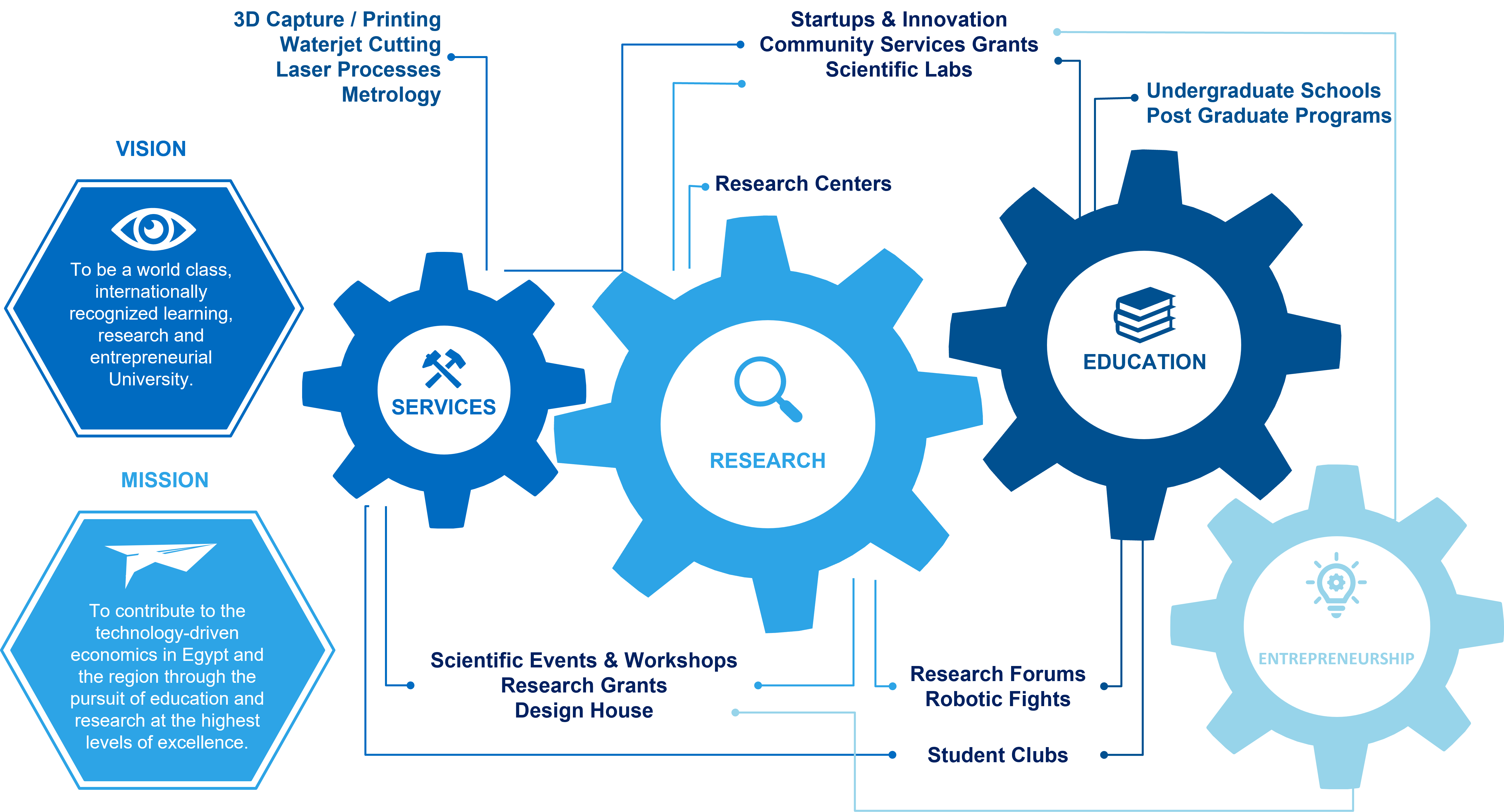
The University aims at achieving comprehensive, international research prominence in diverse fields of scholarly inquiry. The plan is to develop a critical mass of highly qualified researchers with national/international collaboration in multi-disciplinary areas related to novel technologies via knowledge transfer. Additionally, work on the research profile and highlight the research outcomes impacting the university ranking. Endeavoring opportunities of national/international grants related to industry challenges and inspiring experiential learning opportunities that mold our students into the leaders of tomorrow.

Research Mission
- Develop a critical mass of highly qualified researchers.
- Encourage national/international collaboration in multi-disciplinary fields related to novel technologies.
- Improve the knowledge transfer, and research profile, and highlight the research outcomes.
- Attract national/international grants that are related to challenges in industries.
- Enhance the University rankings.
Research Axes
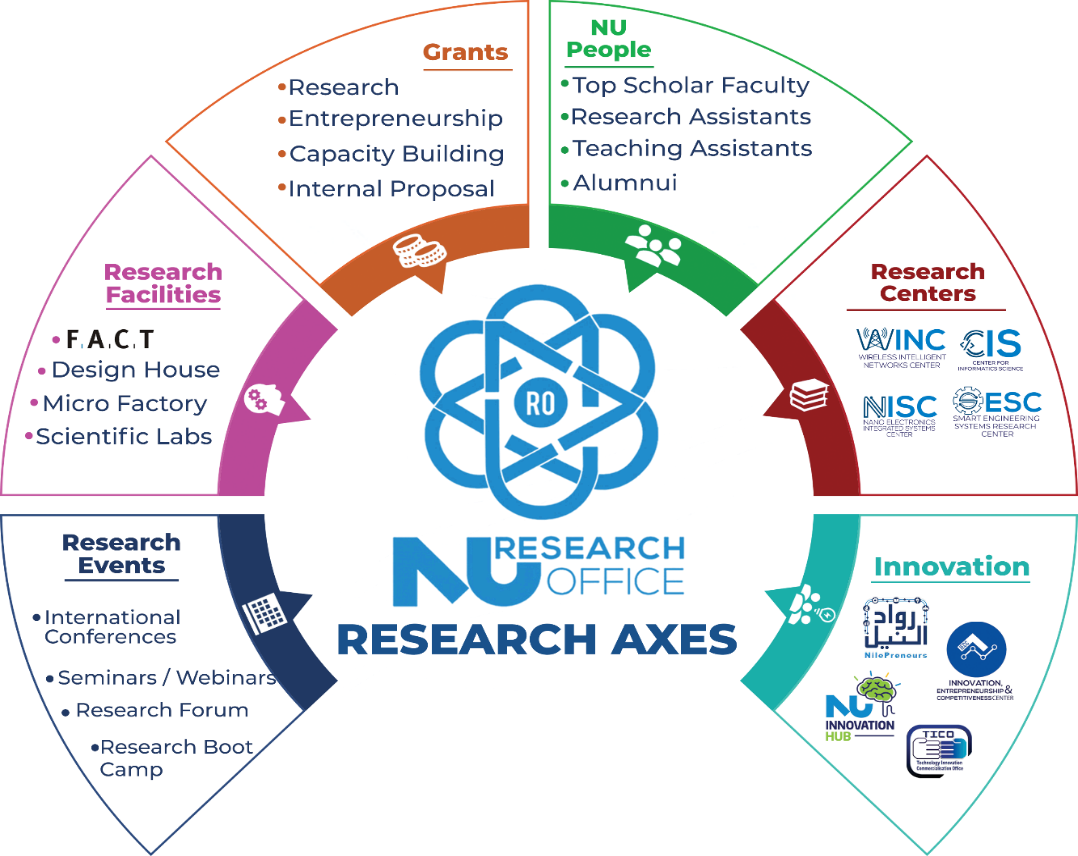
The structure of NU research is different from most Egyptian universities since it depends on six fundamental axes as follows:
- The high profile of faculty members in different tracks and the proper selection of research assistants fully dedicated to their research work and projects. The percentage of NU alumni in multi-national companies and top postgraduate programs in the USA and European universities is relatively high.
- The concept of research centers encourages all professors to collaborate with their teams in a multidisciplinary fashion. NU has five Research Centers in different technological tracks such as Nanoelectronics and recent circuit theory, wireless technologies, computer informatics and big-data, nanotechnology, and intelligent engineering systems.
- Helping startups improve their product and business models and prepare them to scale worldwide. The innovation culture inside NU promotes Entrepreneurship concepts with the help of Innovation Hub and the specialized center IECC, which technically, administratively, and financially guide researchers. As a result, many undergraduate/postgraduate students have their start-ups and incubated companies to realize their ideas.
- The existence of the Grants Office supports the faculty members with all related details for different sponsoring agencies and manages all financial processes with other units inside NU to simplify the resulting reports. During the last 10 years, NU has received many grants from 35 different national and international agencies, most of them for research-oriented projects and more than 15 European projects for capacity-building purposes.
- The technologically based research facilities, scientific labs, and the collaboration/coalition with national and international institutes inside and outside Egypt simplify data collection and processing, especially since the university is open 24 hours a day, 7 days per week.
- The ongoing events inside the university, such as seminars, workshops, invited speakers, boot camps, and the Undergraduate/Postgraduate Research Forums, were initiated five years ago and linked the academic courses with research centers via hundreds of projects running every year. Thus, creating a generation of undergraduate students capable of performing scientific research with all its concepts and fundamentals.
Research Goals
Aims at achieving comprehensive, international research prominence in diverse fields of scholarly inquiry.
|
Quality Attract/Retain Highly Qualified researchers & Vitalize Research Centers |
Impact Focus on Research Areas that Advance knowledge, Impact industry or serve National Agenda |
Internationalization Enhance international collaboration and publishing Rates in multidisciplinary research fields |
|
Grants Improve the awarding rates and values for Sponsored research grant and contracts |
Intellectual Build the NU Intellectual Property (IP) Portfolio |
Ranking Advance/ Promote research output and reputation to enhance NU Ranking |






Research Tracks
Research at Nile University targets areas and challenges of strategic importance to the nation and aims to drive growth for technology-driven economies in Egypt and the region. Applying state-of-the-art technology and capitalizing on strategic academic and industrial partners that are leaders in their fields, NU’s applied research topics address areas such as:


Artificial Intelligence (AI)
Artificial Intelligence (AI)



Software and Communications
Software and Communications



Healthcare
Healthcare



Agriculture and Crops
Agriculture and Crops



Energy and Water
Energy and Water



Mechanical Design
Mechanical Design


Circuit Theory and Applications
Circuit Theory and Applications


Innovation, Entrepreneurship, and Competitiveness
Innovation, Entrepreneurship, and Competitiveness

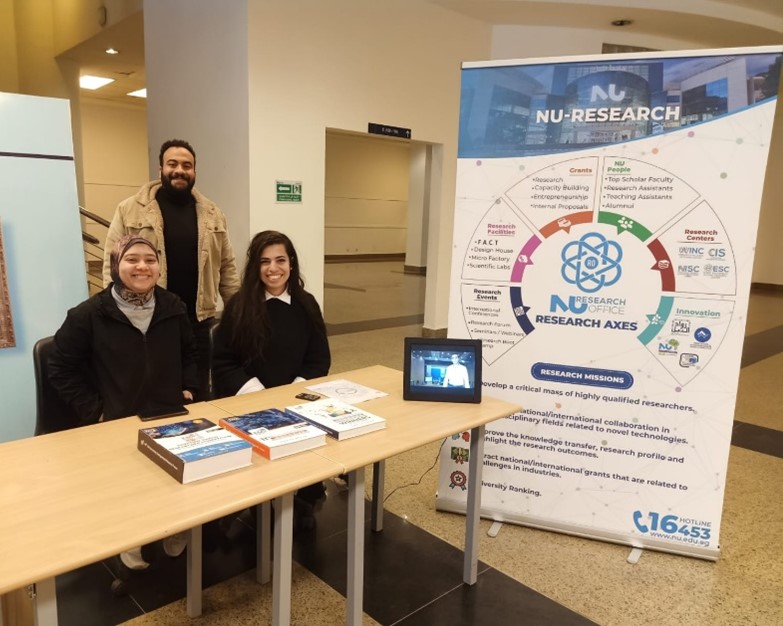
The Research Directions of Nile University in Relation to the National Strategy for Science Technology and Innovation
Research and development of technology are essential for achieving the sustainability goals. Research collaboration and interdisciplinary research are also highly relevant and necessary for progress in sustainability as they serve as incubators of new ideas, inventions and solutions to the many global challenges we face.
Contact Us
For inquiries, please email research.office@nu.edu.eg