



Publications
Publications
Filter by

Malware Detection Techniques
Computers and systems are vulnerable to many threats. Security researchers identified the malware as the major computers and systems threat. Malware can be classified into different types depending on the infection, attacking target, and persistence technique. In this paper, Malware detection techniques are observed with the identification of each technique's strengths and weaknesses points
A Survey on Recommender Systems Challenges and Solutions
A recommender system is a set of tools for information retrieval. It improves access and proactively recommends items and services that match users' tastes by considering their explicit and implicit preferences and behaviors. Recommender systems have become very popular in the e-commerce field. Today, the internet is flooded with diverse information that makes it very difficult for the end-users
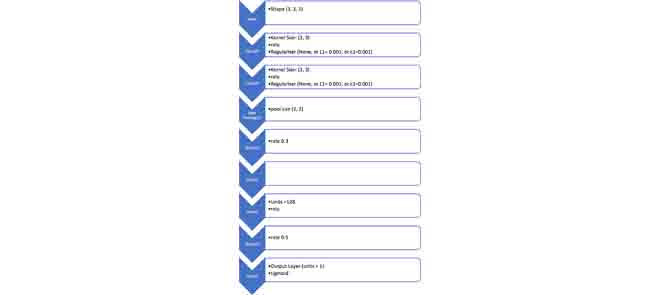
Anomaly Detection Based on CNN and Regularization Techniques Against Zero-Day Attacks in IoT Networks
The fast expansion of the Internet of Things (IoT) in the technology and communication industries necessitates a continuously updated cyber-security mechanism to keep protecting the systems' users from any possible attack that might target their data and privacy. Botnets pose a severe risk to the IoT, they use malicious nodes in order to compromise other nodes inside the network to launch several
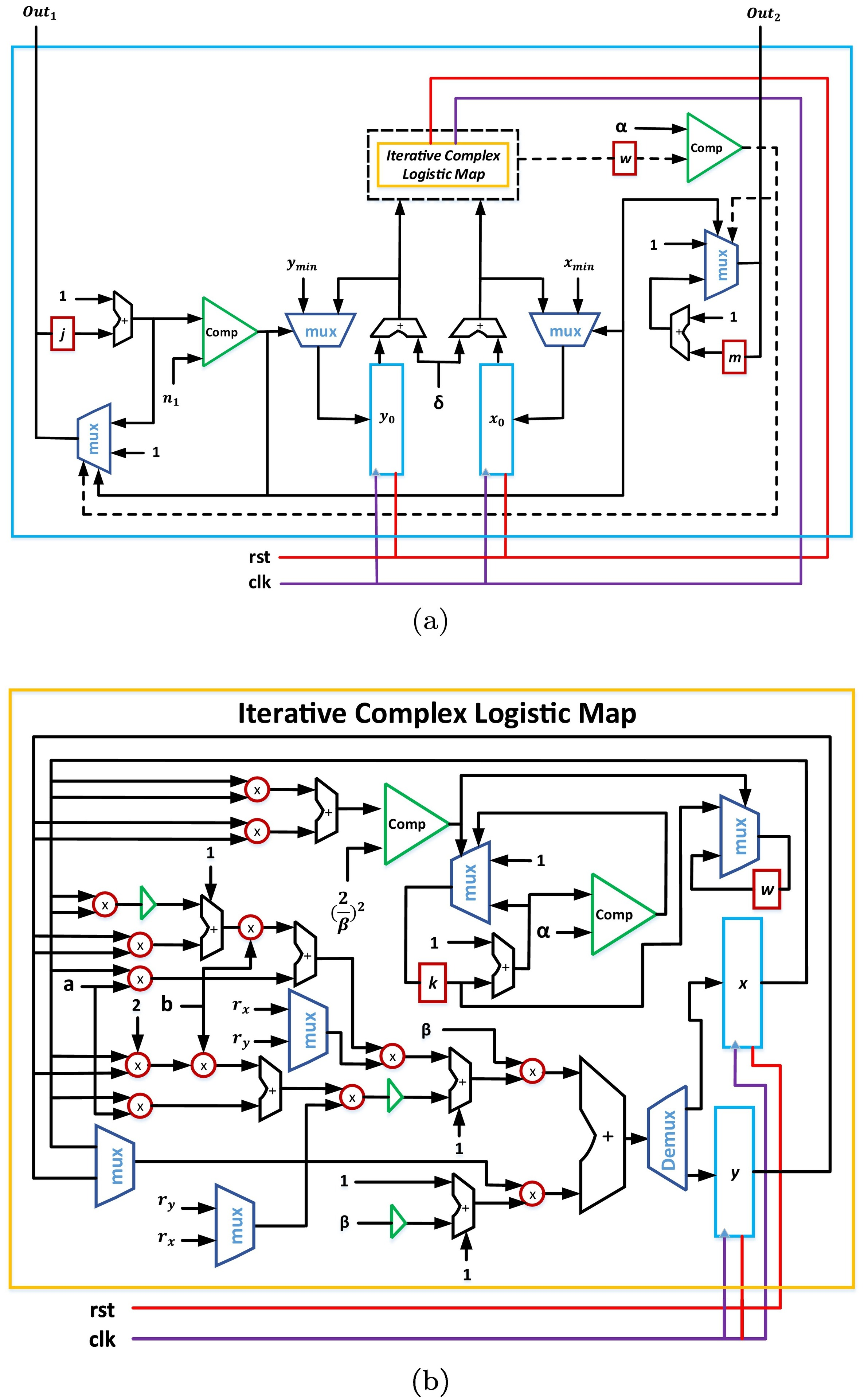
FPGA realization of fractals based on a new generalized complex logistic map
This paper introduces a new generalized complex logistic map and the FPGA realization of a corresponding fractal generation application. The chaotic properties of the proposed map are studied through the stability conditions, bifurcation behavior and maximum Lyapunov exponent (MLE). A relation between the mathematical analysis and fractal behavior is demonstrated, which enables formulating the
Registerless Multiplierless YCoCg-R and YCoCg Color Space Converters Hardware Implementation
Multimedia data, e.g., images and videos, are widely used over the internet and on computers. Image processing applications require color space conversion to be able to deal with these types of data more efficiently. This paper investigates three color space conversions and proposes simplified combinational hardware designs and FPGA realizations for RGB to YCoCg-R and YCoCg color spaces encoders
On Fractional-order Capacitive Wireless Power Transfer System
Wireless power transfer is becoming an increasingly viable solution for the electrical powering of various electronic gadgets. However, precise outputs are not guaranteed with integer systems, so fractional-order capacitors are vital. This paper studies a four-plate fractional capacitive power transfer system by varying six orders of capacitors between the plates along with the load resistance. A
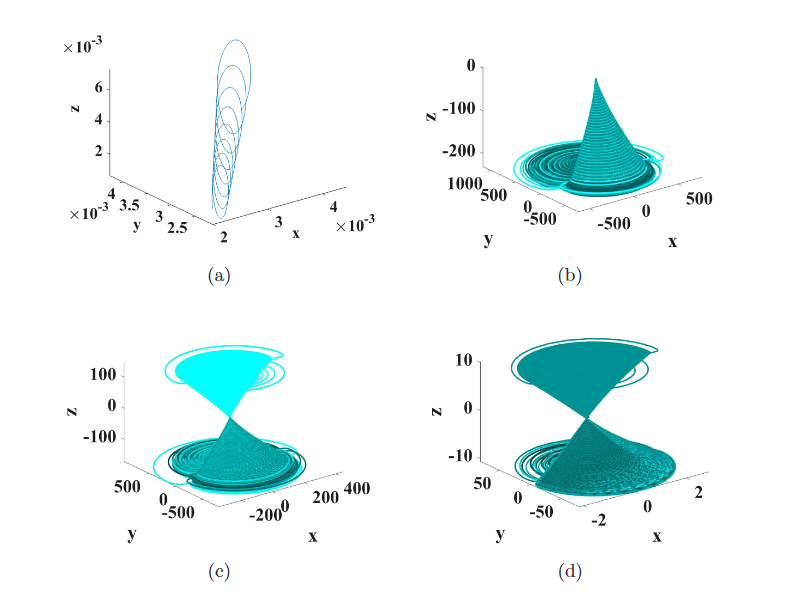
Numerical Sensitivity Analysis and Hardware Verification of a Transiently-Chaotic Attractor
We introduce a new chaotic system with nonhyperbolic equilibrium and study its sensitivity to different numerical integration techniques prior to implementing it on an FPGA. We show that the discretization method used in numerically integrating the set of differential equations in MATLAB and Mathematica does not yield chaotic behavior except when a low accuracy Euler method is used. More accurate
Dual-Level Sensor Selection with Adaptive Sensor Recovery to Extend WSNs’ Lifetime
Wireless sensor networks (WSNs) have garnered much attention in the last decades. Nowadays, the network contains sensors that have been expanded into a more extensive network than the internet. Cost is one of the issues of WSNs, and this cost may be in the form of bandwidth, computational cost, deployment cost, or sensors’ battery (sensor life). This paper proposes a dual-level sensor selection
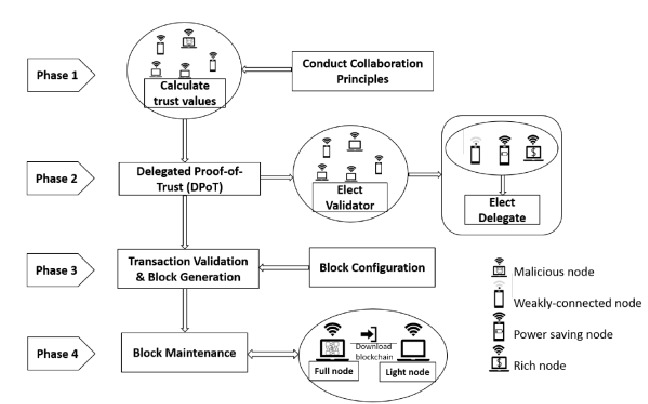
Using Blockchain Technology in MANETs Security
Many systems have recently begun to examine blockchain qualities in order to create cooperation enforcement methods. This paper provides a complete and extensive evaluation of work on multi-hop MANETs with blockchain-based trust control between nodes. We contextualize the snag of security in MANETs resulting from the lack of trust between the participating nodes. We present the blockchain concepts
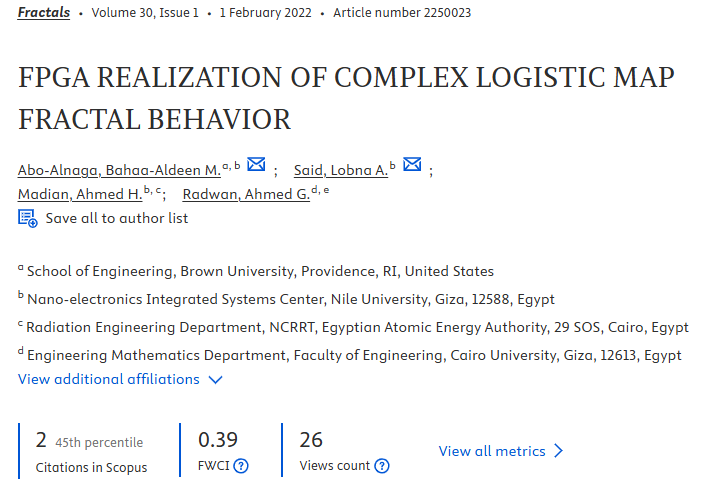
FPGA REALIZATION OF COMPLEX LOGISTIC MAP FRACTAL BEHAVIOR
This paper studies the capability of digital architecture to mimic fractal behavior. As chaotic attractors realized digitally had opened many tracks, digital designs mimicking fractals may ultimately achieve the same. This study is based on a complex single-dimensional discrete chaotic system known as the generalized positive logistic map. The fractals realized from this system are linked to the