



Publications
Publications
Filter by
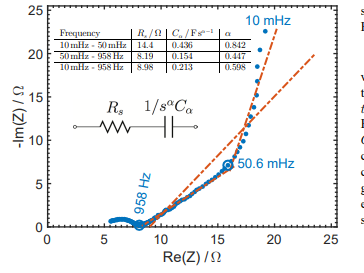
Further experimental evidence of the fractional-order energy equation in supercapacitors
Due to the dispersive porous nature of its material, carbon–carbon supercapacitors have a current–voltage relationship which is modeled by a fractional-order differential equation of the form i(t)=Cα[Formula presented] where α≤1 is a dispersion coefficient and Cα is a pseudo-capacitance not measurable in Farads. Hence, the energy stored in a capacitor, known to equal CV2/2 where C is the
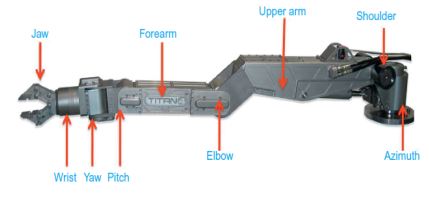
Control design approaches for parallel robot manipulators: A review
In this article, different control design approaches for parallel robot manipulators are presented with two distinguished classes of control strategies in the literature. These are the model-free control and the dynamic control strategy, which is mainly a model-based scheme, and is mostly the alternative when the control requirements are more stringent. The authors strongly believe that this paper
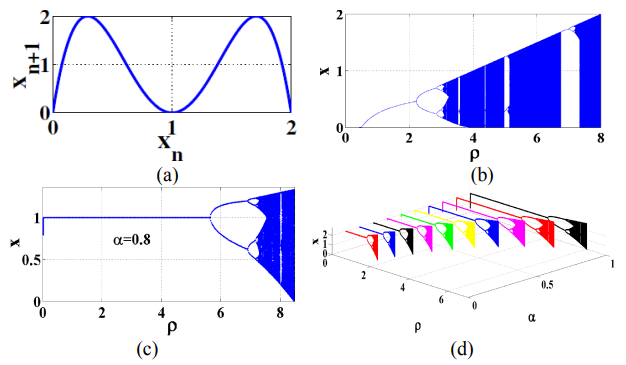
Biomedical image encryption based on double-humped and fractional logistic maps
This paper presents a secured highly sensitive image encryption system suitable for biomedical applications. The pseudo random number generator of the presented system is based on two discrete logistic maps. The employed maps are: the double humped logistic map as well as the fractional order logistic map. The mixing of the map parameters and the initial conditions x0, offers a great variety for
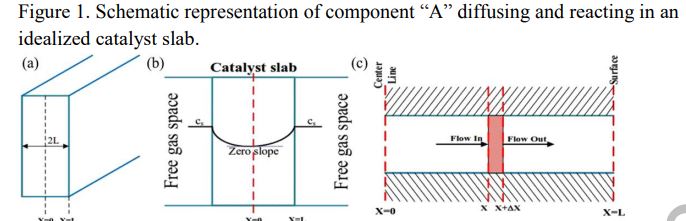
Controlled Picard Method for Solving Nonlinear Fractional Reaction–Diffusion Models in Porous Catalysts
This paper discusses the diffusion and reaction behaviors of catalyst pellets in the fractional-order domain as well as the case of nth-order reactions. Two generic models are studied to calculate the concentration of reactant in a porous catalyst in the case of a spherical geometric pellet and a flat-plate particle with different examples. A controlled Picard analytical method is introduced to
A study on coexistence of different types of synchronization between different dimensional fractional chaotic systems
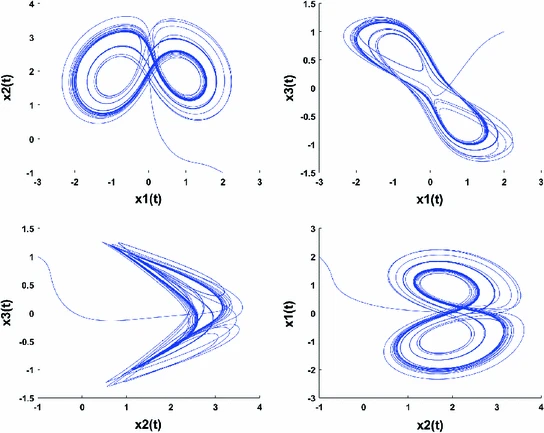
In this study, robust approaches are proposed to investigate the problem of the coexistence of various types of synchronization between different dimensional fractional chaotic systems. Based on stability theory of linear fractional order systems, the co-existence of full state hybrid function projective synchronization (FSHFPS), inverse generalized synchronization (IGS), inverse full state hybrid
A study on coexistence of different types of synchronization between different dimensional fractional chaotic systems
In this study, robust approaches are proposed to investigate the problem of the coexistence of various types of synchronization between different dimensional fractional chaotic systems. Based on stability theory of linear fractional order systems, the co-existence of full state hybrid function projective synchronization (FSHFPS), inverse generalized synchronization (IGS), inverse full state hybrid

Decentralized coded caching in wireless networks: Trade-off between storage and latency
This paper studies the decentralized coded caching for a Fog Radio Access Network (F-RAN), whereby two edge-nodes (ENs) connected to a cloud server via fronthaul links with limited capacity are serving the requests of K r users. We consider all ENs and users are equipped with caches. A decentralized content placement is proposed to independently store contents at each network node during the off
Stability analysis for multi-user cooperative cognitive radio network with energy harvesting
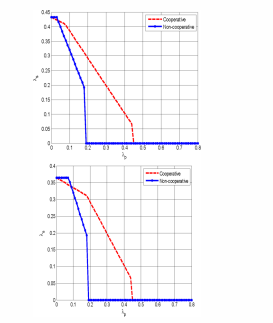
This paper deals with stability analysis for cognitive cooperative system composed of one primary user and many secondary users with energy harvesting imposed at both primary and secondary users. Secondary users are grouped in a cluster with a cluster supervision block (CSB) controller which controls and synchronizes all the activities of the SU cluster. The secondary user cluster is equipped with
Stability analysis of a cognitive radio system with a dedicated relay
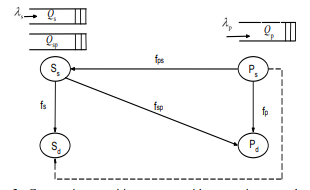
In this paper, we characterize the stability region of cognitive radio networks with a dedicated relay node. In particular, we study this system under two different MAC protocols: perfect sensing and random access. In the perfect sensing protocol, the relay node and the secondary user access the medium only when the primary user is idle. In the random access protocol, both the relay and the
Cost-Effective Data Transfer for Mobile Health Care
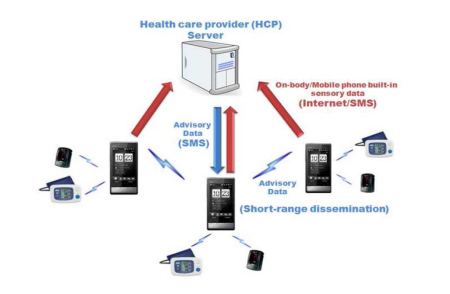
In this paper, we introduce the novel concept of cost-effective mobile health care which leverages the multiple wireless interfaces onboard most mobile phones today. First, we study the problem of uploading medical data using the 'least cost' radio interface. Toward this objective, we propose the wireless interface selection algorithm (WISA) which decides the wireless interface yielding the least