

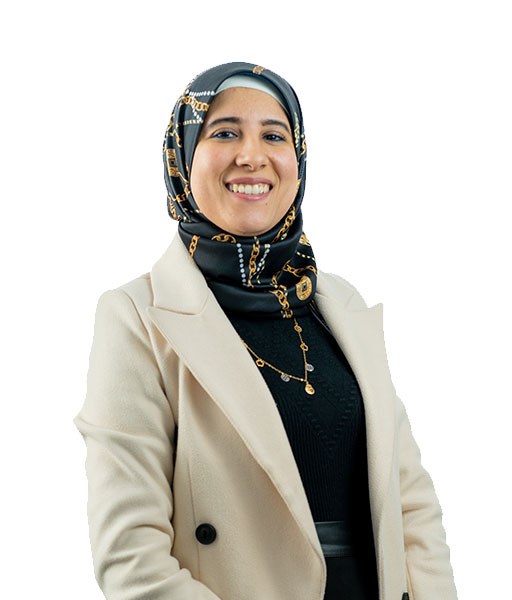


Dr. Ethar A. Abdel Salam
Associate Professor
Faculty Building
UB1
Office Number
303
I am an Associate Professor in the School of Engineering and Applied Sciences at Nile University. I earned my PhD in Applied Mathematics from Cairo University in 2020, where my research focused on the thermo-piezo elasticity of continuous media with microstructure within the framework of extended thermodynamics. My doctoral work was honored with several awards, including the Obada Prize for Distinguished Students and the Best Ph.D. Thesis Award in Applied Mathematics from the Egyptian Mathematical Society (2021).
Before my PhD, I completed a BSc in Special Mathematics from the Faculty of Science at Al-Azhar University and an MSc in Applied Mathematics from the Faculty of Science at Zagazig University.
My research interests lie primarily in continuum mechanics and thermoelasticity. I have published over 20 peer-reviewed articles in top-tier journals and regularly serve as a reviewer for leading journals in the field. I’ve had the privilege of presenting my work at various scientific conferences, such as the 8th International Scientific Conference on Environment, Development and Bioinformatics, the 8th International Conference on Mathematics and Information Sciences, and International Mathematics Day – Mathematics for Development.
In 2023 and 2024, I was invited as a visiting scholar to Prof. Khuri-Yakub’s lab in the Electrical Engineering Department at Stanford University, where I contributed to the development of transparent piezoelectric transducers for neuron stimulation. I also received the Best Research Award for Egyptian Young Researchers at the 4th International Conference for Mathematics and its Applications (2021) and was awarded the Chebyshev Grant from the International Congress of Mathematicians (ICM) in 2022.
At Nile University, I teach several core undergraduate courses and actively engage in mentoring student researchers. I’ve served as a jury member for the Egyptian Junior Researcher Competition and take pride in guiding the next generation of engineers and scientists as they develop innovative projects and share their work at conferences and in scientific journals.
Research summary: My research focuses on the development of mathematical models for piezoelectric materials for various applications including energy harvesting and sensing. Using tools from continuum mechanics and extended thermodynamics, I work on modeling the coupled behavior between mechanical, thermal, and electrical fields in piezoelectric media. Currently, I am a CO-PI on an STDF-funded project on piezoelectric energy harvesting for renewable energy applications. This project focuses on developing piezoelectric systems for harvesting mechanical vibrations from the environment. I am also engaged in an international research collaboration with Stanford University, in E.L. Ginzton Lab as a visiting scholar where I work on the theoretical modeling of transparent piezoelectric transducers for neuron stimulation. My work has been recognized by multiple awards including Chebyshev grant award, the best Ph.D. Thesis award, the best research award for Egyptian young researchers and the Obada-Prize.
- Dr. Ethar won Obada Prize 2020 for Distinguished Students.
- She won the Best Ph.D. Thesis Award in "Applied Mathematics" from the Egyptian Mathematical Society for the year 2021.
- She also won the Best Research Award for Egyptian Young Researchers at the Fourth International Conference for Mathematics and its Applications, 2021.
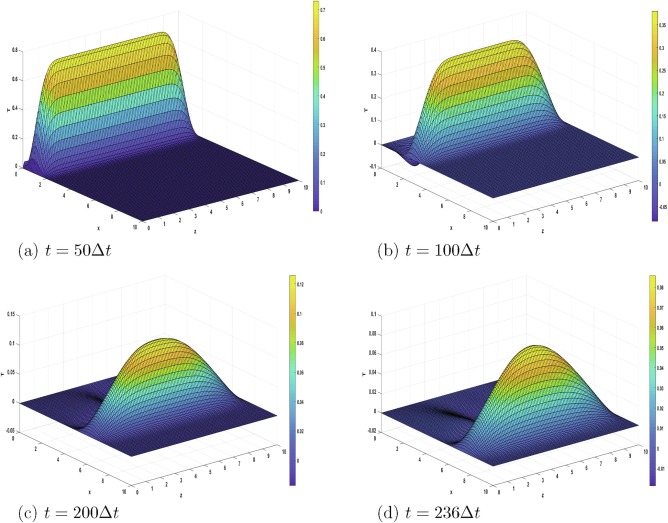
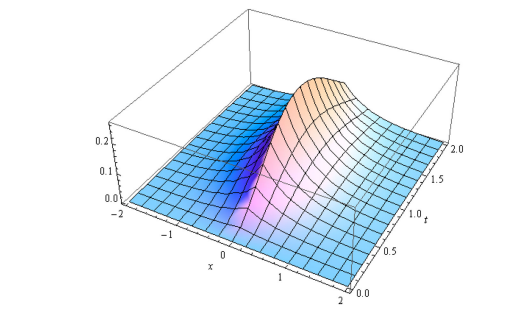
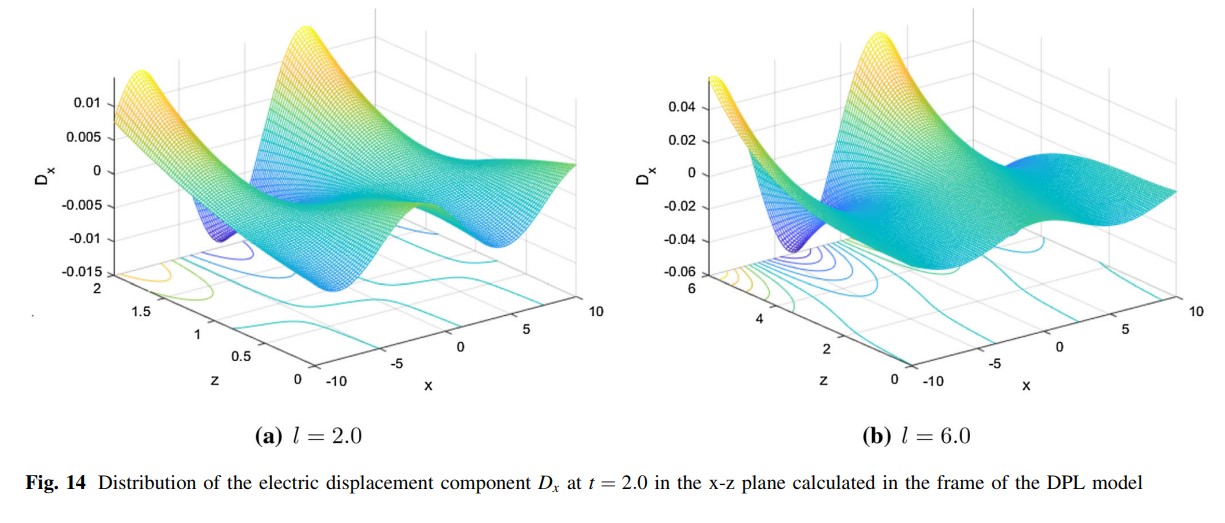

One-dimensional nonlinear model of generalized thermo-electro elasticity.