




Egypt's plastics in 2050: what a foresight exercise with industry revealed
By Ahmed Saleh, Executive Director, IECC (Innovation, Entrepreneurship and Competitiveness Center), Nile University, and Irene Samy, Director, SESC (Smart Engineering Systems Research Center) and Professor of Industrial Engineering, Nile University
Forecasting where Egypt's plastic problem is headed is not crystal-ball gazing. Done properly, it is a structured exercise: you take a credible baseline, bring the people who actually run the value chain into the room, and have them reason through what is feasible, by when, and at what scale of impact. As part of the UNIDO mapping study, we ran exactly that exercise with government officials, industry leaders, recyclers, and NGOs. What came out is a clearer, and more sober, picture than the usual targets allow.
How the forecast was built
We did not start by asking people to dream. We started with numbers. Participants were given Egypt's current consumption, waste, and recycling figures, which government officials reviewed and corrected on the spot, alongside forecasts of global plastic production and recycling trends and a business-as-usual baseline for Egypt.
Against that baseline, each proposed alternative was scored on two axes: the time horizon before it would realistically deliver impact, sorted into short, medium, and long term, and the scale of that impact. We also tracked a consensus indicator, the share of experts who agreed on each alternative's timing, because an idea that everyone rates highly but no one agrees on the timing of is a weaker bet than the average alone suggests.
Structured foresight and technology forecasting of this kind sit at the core of the management of technology field, and are among the methods taught in Nile University's Graduate School of Management of Technology.
Participants then projected Egypt's plastic mix for 2030 and 2050 and built recommendations around technology adoption, standards, and regulation. The point of the method is that the resulting targets are owned by the people who would have to hit them, not handed down to them.
What the experts prioritized
The single highest-impact intervention, in the experts' view, was not a new material. It was a strong waste management system, which scored higher on impact than any other option and was judged feasible in the short term. Right behind it came reuse business models and reducing packaging weight, both also near-term.
Recycling of PET and HDPE landed a tier lower, and the reason is instructive. Recycling is not held back mainly by recycling technology. It is held back by the waste management system that feeds it. Until collection and sorting improve, better recycling capacity has less to work with. The sequencing matters: fix the feedstock problem first, and the materials-level gains follow.
The exercise also surfaced how interdependent these moves are. Zero-waste stores and in-store reuse enable each other. Refill-at-home cannot scale without reverse logistics, especially for smaller companies. Where participants overlooked those dependencies, consensus dropped, which is itself a useful signal about where a plan is fragile.
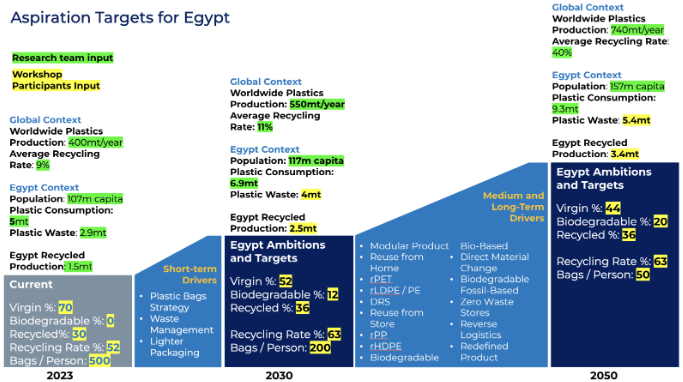
Expert foresight projections for Egypt, 2023 baseline to 2030 and 2050 (UNIDO, 2025).
The mix improves. The pile still grows.
Here is the headline, and the part that is easy to get wrong if you only read the percentages.
By 2030, the experts project Egypt's reliance on virgin plastic falling from 70 percent of usage to 52 percent, biodegradable materials rising from essentially zero to 12 percent, and the post-consumer recycling rate climbing from 52 percent to 63 percent. By 2050, virgin drops further to 44 percent and biodegradables reach 20 percent. On the mix, this is real, directional progress.
But the absolute volumes move the other way. Egypt's plastic consumption is projected to rise from about 5 million tonnes in 2023 to 6.9 million by 2030 and 9.3 million by 2050, driven by a population heading toward 157 million and continued economic growth. Post-consumer plastic waste climbs from 2.9 million tonnes to a projected 5.4 million over the same period.
So even in an optimistic scenario where the mix gets substantially cleaner, the total pile of plastic and plastic waste keeps getting bigger. Improving the percentages is not the same as shrinking the problem. Both have to be worked at once, and any plan that celebrates a falling virgin-plastic share while ignoring rising absolute tonnage is telling half the story.
One bright spot worth stating plainly: Egypt's current post-consumer recycling rate, at 52 percent, is already far above the global average of around 9 percent. That is a genuine strength to build on, much of it driven by the informal sector.
|
Indicator |
2023 |
2030 |
2050 |
|
Plastic consumption (Egypt) |
5.0 Mt |
6.9 Mt |
9.3 Mt |
|
Post-consumer plastic waste |
2.9 Mt |
4.0 Mt |
5.4 Mt |
|
Virgin plastic share |
70% |
52% |
44% |
|
Biodegradable materials share |
0% |
12% |
20% |
|
Post-consumer recycling rate |
52% |
63% |
63% |
|
Plastic bags per person / year |
~500 |
~200 |
target 50 |
Expert foresight projections for Egypt, 2023 baseline to 2050 (UNIDO, 2025).
Honest about the limits
Two cautions came with these projections, and we keep them attached.
First, the numbers are estimates, derived in part by applying Egypt's share of global consumption to international forecasts. Economic shocks, growth, or shifts in petroleum and gas availability could move them significantly. They are a reference point for planning, not a prediction.
Second, ambition met reality on the plastic bag target. Egypt's national strategy aims for 50 bags per person per year. The experts in the room judged that unrealistic by 2030, given the scale of informal-sector supply and current economic conditions, and landed instead on roughly 200 bags per person, down from about 500 today. That divergence between the official target and the expert view is not a flaw in the exercise. It is the value of it. A target that the value chain considers impossible will not be met by restating it more loudly.
Why this kind of foresight matters
Numbers like these let a government set targets it can defend, a sponsor fund the interventions that actually move the needle, and an investor see which alternatives have a realistic runway and which are a decade early. Producing them, structured foresight that turns expert judgment into defensible, consensus-weighted projections, is the kind of technology forecasting the Innovation, Entrepreneurship and Competitiveness Center (IECC) does. Paired with the materials assessment work of the Smart Engineering Systems Research Center (SESC), it connects where the science is going with how fast the market and the policy environment can realistically follow.
The honest forecast for 2050 is not that Egypt's plastic problem will disappear. It is that the country can change what its plastic is made of and how much of it is recovered, while the volume keeps rising underneath. Planning for both at once is the whole task.
Acknowledgments
This series draws on a study made possible by many hands. We thank our co-authors Sherifa ElHady, ElHassan ElSabry, Amira Yassin, Sherif Hamed, Rana Adel, and Amir Azmy, and we are grateful to Asmaa Ahmed, Amr Hashim, Dina Tolba, Marwan Rashwan, and Salma Salah for their critical contributions. We also thank Asmaa Ahmed and Merna Hammad of Nile University, whose coordination and industry engagement were instrumental to the work.
We are grateful to Matthias Pfaff and Nahomi Nishio at UNIDO Headquarters, and to Eman Shaaban, Ahmed Ibrahim, and Abdulrahman Hag Elamin at the UNIDO Egypt office, for their guidance and for facilitating access to key data. Finally, we thank the Ministry of Environment and the industry leaders, policymakers, NGOs, and private-sector representatives who gave their time to the interviews and the validation workshop, and the Government of Japan, whose funding made the study possible.
About the authors
Ahmed Saleh is the Executive Director of the Innovation, Entrepreneurship and Competitiveness Center (IECC) at Nile University, where he works at the intersection of technology management, innovation, and entrepreneurship to strengthen industry competitiveness in Egypt and the region. An engineer by training, he has led innovation and venture-building programs, including work with Nile University's NilePreneurs initiative. He is currently a PhD candidate at Nile University's Graduate School of Management of Technology (MOT), where his research interests include technology commercialization in developing economies and digital transformation strategies.
Irene Samy Fahim is a Professor in the Industrial and Service Engineering and Management department at Nile University and Director of the Smart Engineering Systems Research Center (SESC). A Fulbright alumna, she holds a PhD in Mechanical Engineering from the American University in Cairo. Her research centers on sustainable materials, including bioplastics, natural-fiber-reinforced composites, and non-plastic single-use tableware made from sugarcane bagasse. She is a Senior Member of the IEEE and a recipient of the L'Oreal-UNESCO For Women in Science award (Egypt, 2021), the State Encouragement Award for Women (2020), and the Hazem Ezzat Research Excellence Award (2021).
Read the full study: Mapping Study of Alternatives to Single-Use Plastics: Reducing Single-Use Plastics in Egypt (UNIDO, 2025), commissioned under the project "Supporting the Promotion of Circular Economy Practices in the Single-Use Plastic Value Chain," with funding from the Government of Japan.
About the centers: The Innovation, Entrepreneurship and Competitiveness Center (IECC) and the Smart Engineering Systems Research Center (SESC) at Nile University.