


Why "biodegradable" isn't a finish line: PLA, bioplastics, and the supply-chain catch
By Irene Samy, Director, SESC (Smart Engineering Systems Research Center) and Professor of Industrial Engineering, Nile University, and Ahmed Saleh, Executive Director, IECC (Innovation, Entrepreneurship and Competitiveness Center), Nile University
Why "biodegradable" isn't a finish line: PLA, bioplastics, and the supply-chain catch
By Ahmed Saleh, Executive Director, IECC (Innovation, Entrepreneurship and Competitiveness Center), Nile University, and Irene Samy, Director, SESC (Smart Engineering Systems Research Center) and Professor of Industrial Engineering, Nile University
There is a narrative about sustainable packaging that goes like this: stop using fossil-based plastic, switch to a biodegradable material, and the problem is solved. The word "biodegradable" on the label feels like a finish line.
In our work on the UNIDO mapping study, we found that it is closer to a starting line, and that crossing it in Egypt is harder than the marketing suggests. The reasons are partly about chemistry and partly about supply chains, and they matter to anyone deciding whether to put "green" material into a real production line.
Bio-based does not mean biodegradable
Start with the most common misconception. People assume that "bio-based" and "biodegradable" are the same thing, and that fossil-based plastics are the opposite. Neither is true.
A plastic's source and its end-of-life behavior are two separate questions. Some plastics made from plants do not break down at all. The "drop-in" bioplastics, such as Bio-PE, Bio-PET, and Bio-PP, are chemically identical to their fossil cousins and are just as persistent in the environment. They are made partly from biomass, but they are not biodegradable. Bio-PET, for instance, can carry the bio-based label while about a third of it only comes from plant material.
It runs the other way too. Several biodegradable plastics, including PBS, PVA, and PBAT, are made from fossil fuels. So a material can be petroleum-derived and still break down, or plant-derived and last for centuries. The source does not determine the final fate.
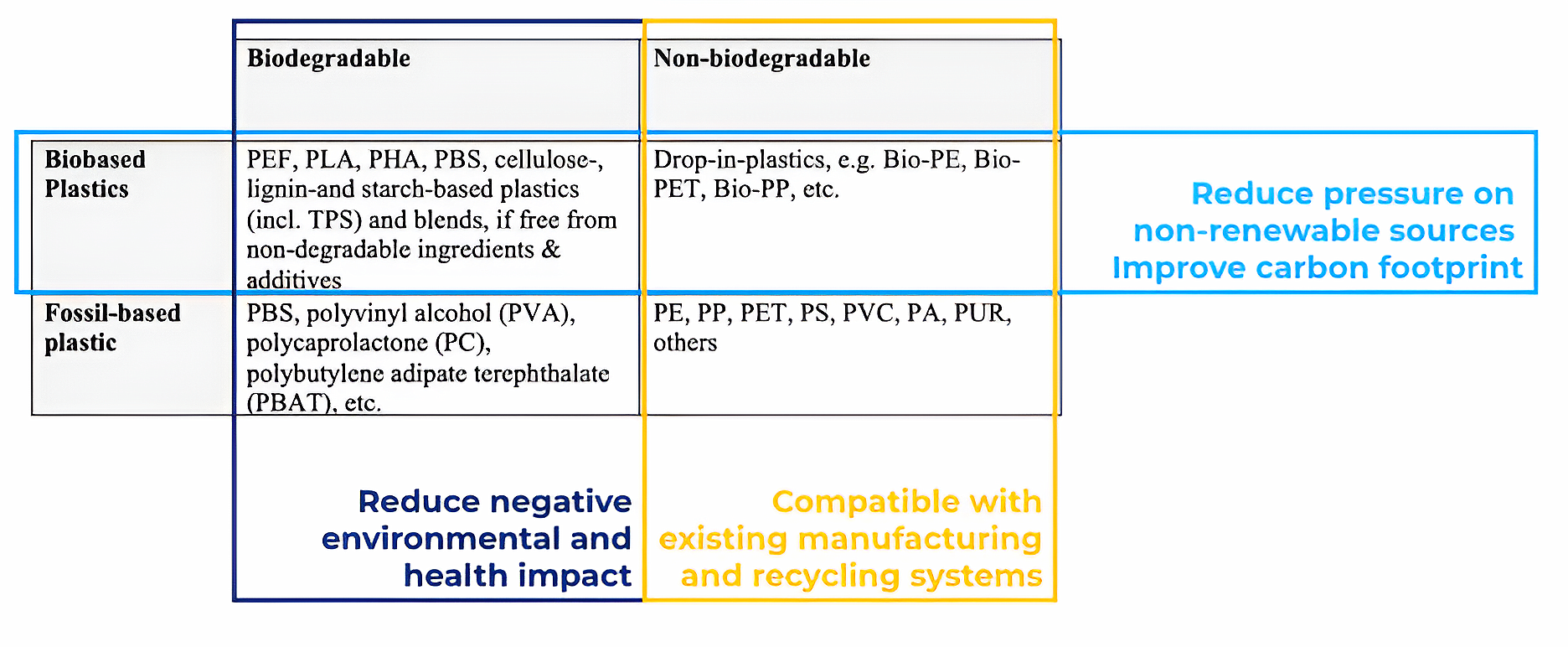
This is not a technicality. A business that switches to a bio-based drop-in thinking it has solved its waste problem has changed where its carbon comes from, which can be worthwhile, but it has not made anything that disappears at end of life. Knowing which box a given material sits in, bio-based or fossil-based, biodegradable or not, is the first thing a materials assessment establishes, and it is the difference between a real environmental gain and a relabeling exercise.
The alternatives are real, but still a sliver
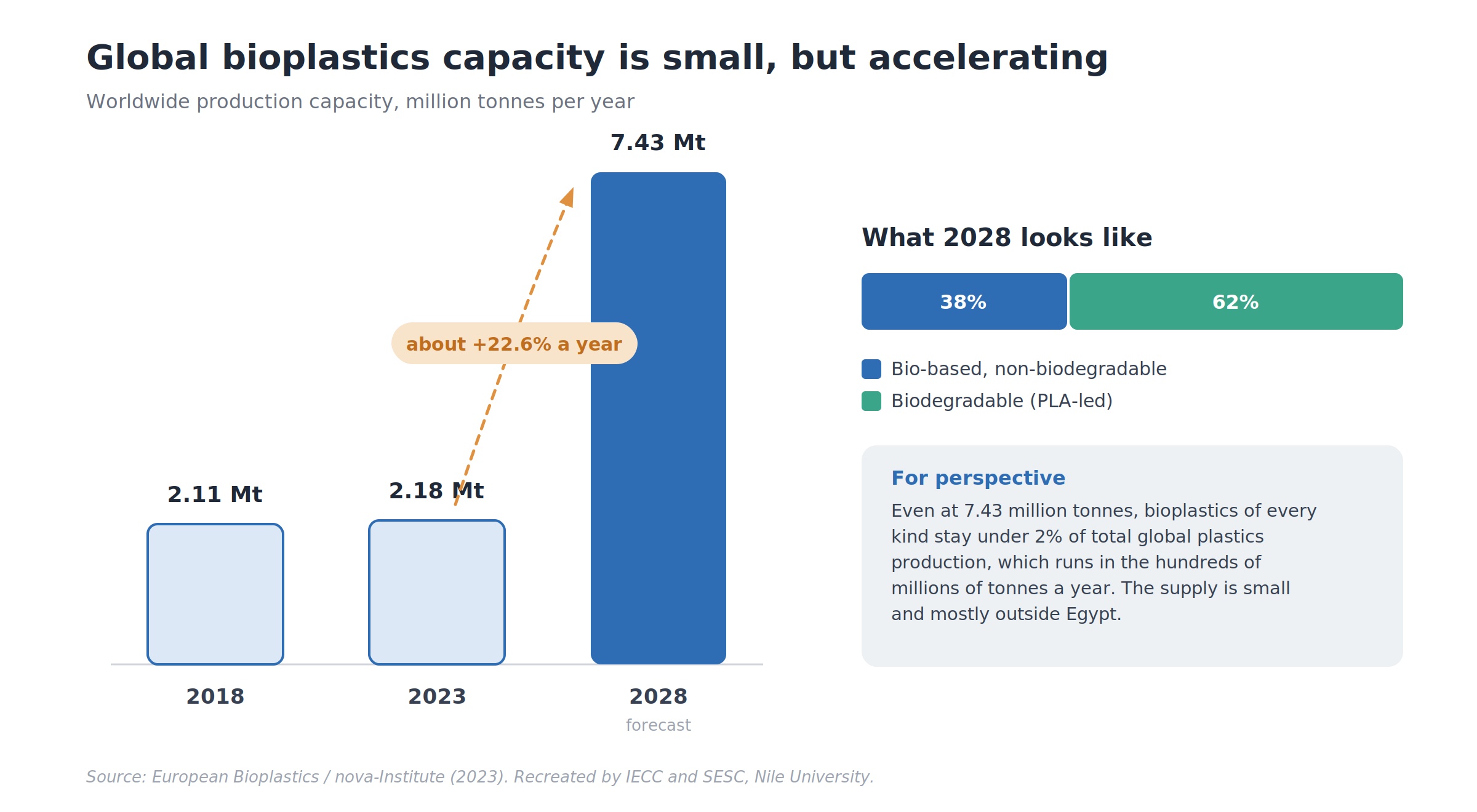
The genuinely biodegradable bio-based materials, such as PLA, PHA, and starch blends, do exist and are growing fast. Global bioplastics production reached about 2.18 million tonnes in 2023 and is projected to grow strongly over the next several years.
For perspective, the world produces hundreds of millions of tonnes of conventional plastic a year. Bioplastics of every kind are still a fraction of one percent of that. The supply is small, it is concentrated outside Egypt, and that scarcity shows up directly as cost and availability at the factory gate here.
The Egyptian supply-chain catch
This is where the finish-line story breaks down in practice. The manufacturers we interviewed were not hostile to alternatives. They had tried them, and run into walls.
Take PLA, the best-known biodegradable plastic. In Egypt it is used mostly in niche, high-value packaging, things like premium fish and specialty foods, precisely because it is expensive. Beyond cost, it brings processing problems that do not appear in a brochure. Trials with PLA imported from China and Italy failed when the material crystallized during storage, which then compromised how it responded to heat in production. One FMCG producer could not validate PLA through a lamination step that runs at 200 to 240 degrees Celsius. Several companies estimated that switching would mean reinvesting between half and all of their existing capital expenditure in new equipment and specialized storage.
And looming over all of it is a blunt commercial fact that one packaging company put plainly: clients care about price and quality, not whether the bag is biodegradable. Until that changes, or until policy changes it, the premium material loses the sale.
Recycled plastic, the other materials route, hits a different version of the same problem. It is cheaper than virgin only by a slim margin, around 10 to 15 percent for HDPE, and that saving evaporates against the productivity cost. One producer's molding time jumped from 30 seconds to 48 seconds per unit when running just 20 percent recycled content, alongside familiar complaints about odor, texture, and inconsistent properties. The math only works in low-value, thick-walled products like fertilizer bags and chemical barrels, where tight tolerances do not matter, or when a client in an export market requires it.
The real work is matching and validating
None of this is an argument against alternative materials. It is an argument against treating them as a single switch you flip. The lesson from the study is that the right material depends on the application, the processing conditions, and the cost tolerance of that specific product, and that the only way to know whether a substitution actually works is to test it under real production conditions rather than trusting the label.
That testing is the core of what the Smart Engineering Systems Research Center (SESC) does: evaluating which alternative materials genuinely perform for a given use, and assessing across the full life cycle whether a switch is a real environmental improvement or simply a costlier way to make the same footprint. In our next piece, we put numbers to exactly that question for recycled PET and HDPE, and show what the life-cycle assessment actually says.
The word "biodegradable" is a fine place to start a conversation. It is a poor place to end one.
Acknowledgments
This series draws on a study made possible by many hands. We thank our co-authors Sherifa ElHady, ElHassan ElSabry, Amira Yassin, Sherif Hamed, Rana Adel, and Amir Azmy, and we are grateful to Asmaa Ahmed, Amr Hashim, Dina Tolba, Marwan Rashwan, and Salma Salah for their critical contributions. We also thank Asmaa Ahmed and Merna Hammad of Nile University, whose coordination and industry engagement were instrumental to the work.
We are grateful to Matthias Pfaff and Nahomi Nishio at UNIDO Headquarters, and to Eman Shaaban, Ahmed Ibrahim, and Abdulrahman Hag Elamin at the UNIDO Egypt office, for their guidance and for facilitating access to key data. Finally, we thank the Ministry of Environment and the industry leaders, policymakers, NGOs, and private-sector representatives who gave their time to the interviews and the validation workshop, and the Government of Japan, whose funding made the study possible.
About the authors
Ahmed Saleh is the Executive Director of the Innovation, Entrepreneurship and Competitiveness Center (IECC) at Nile University, where he works at the intersection of technology management, innovation, and entrepreneurship to strengthen industry competitiveness in Egypt and the region. An engineer by training, he has led innovation and venture-building programs, including work with Nile University's NilePreneurs initiative. He is currently a PhD candidate at Nile University's Graduate School of Management of Technology (MOT), where his research interests include technology commercialization in developing economies and digital transformation strategies.
Irene Samy Fahim is a Professor in the Industrial and Service Engineering and Management department at Nile University and Director of the Smart Engineering Systems Research Center (SESC). A Fulbright alumna, she holds a PhD in Mechanical Engineering from the American University in Cairo. Her research centers on sustainable materials, including bioplastics, natural-fiber-reinforced composites, and non-plastic single-use tableware made from sugarcane bagasse. She is a Senior Member of the IEEE and a recipient of the L'Oreal-UNESCO For Women in Science award (Egypt, 2021), the State Encouragement Award for Women (2020), and the Hazem Ezzat Research Excellence Award (2021).
Read the full study: Mapping Study of Alternatives to Single-Use Plastics: Reducing Single-Use Plastics in Egypt (UNIDO, 2025), commissioned under the project "Supporting the Promotion of Circular Economy Practices in the Single-Use Plastic Value Chain," with funding from the Government of Japan.
About the centers: The Innovation, Entrepreneurship and Competitiveness Center (IECC) and the Smart Engineering Systems Research Center (SESC) at Nile University.