


Egypt uses 5 million tonnes of plastic a year. Here's the map to using less
By Ahmed Saleh, Executive Director, IECC (Innovation, Entrepreneurship and Competitiveness Center), Nile University, and Irene Samy, Director, SESC (Smart Engineering Systems Research Center) and Professor of Industrial Engineering, Nile University
Every year, Egypt consumes about 5 million tonnes of plastic and throws away close to 2.9 million tonnes of plastic waste. Three polymers, PET, polyethylene, and polypropylene, make up 87 percent of that waste. Put another way, the average person in Egypt goes through somewhere between 350 and 560 plastic bags a year. The national target is to bring that down to 50 by 2030.
Those numbers are the starting point of a mapping study we recently completed for the United Nations Industrial Development Organization (UNIDO), with funding from the Government of Japan. The study asked a deceptively simple question: what are the real alternatives to single-use plastics in Egypt, and which of them actually work here, given our costs, our supply chains, and our consumers?
The study evaluated technical, economic, environmental, and consumer dimensions of alternatives to single-use plastics in Egypt.
This article is the first in a series drawn from that study. Before we get into specific alternatives in the pieces that follow, it helps to lay out the map: why the obvious answer is the wrong one, and where the real opportunities sit.
The ban instinct, and why it backfires
When most people hear "single-use plastics," the first reaction is to ban them. It feels decisive, and in some places it was tried. Several countries have cut plastic bag use by as much as 96 percent through bans and levies.
But a ban applied without a plan can do real damage. Packaging alone accounts for 38 percent of plastic raw material use in Egypt, so a sudden ban would hit manufacturers, jobs, and investment hard. The cautionary example is Kenya, where an estimated 60,000 jobs were lost, and 176 manufacturers closed after the 2017 bag ban. Bans can also backfire on the environment when the replacement material has a heavier environmental footprint of its own.
The lesson is not that policy doesn't matter. It's that reducing single-use plastics is not one decision. It's a portfolio of them.
Better, less, no: three strategies, not one
The study sorts the alternatives into three strategies.
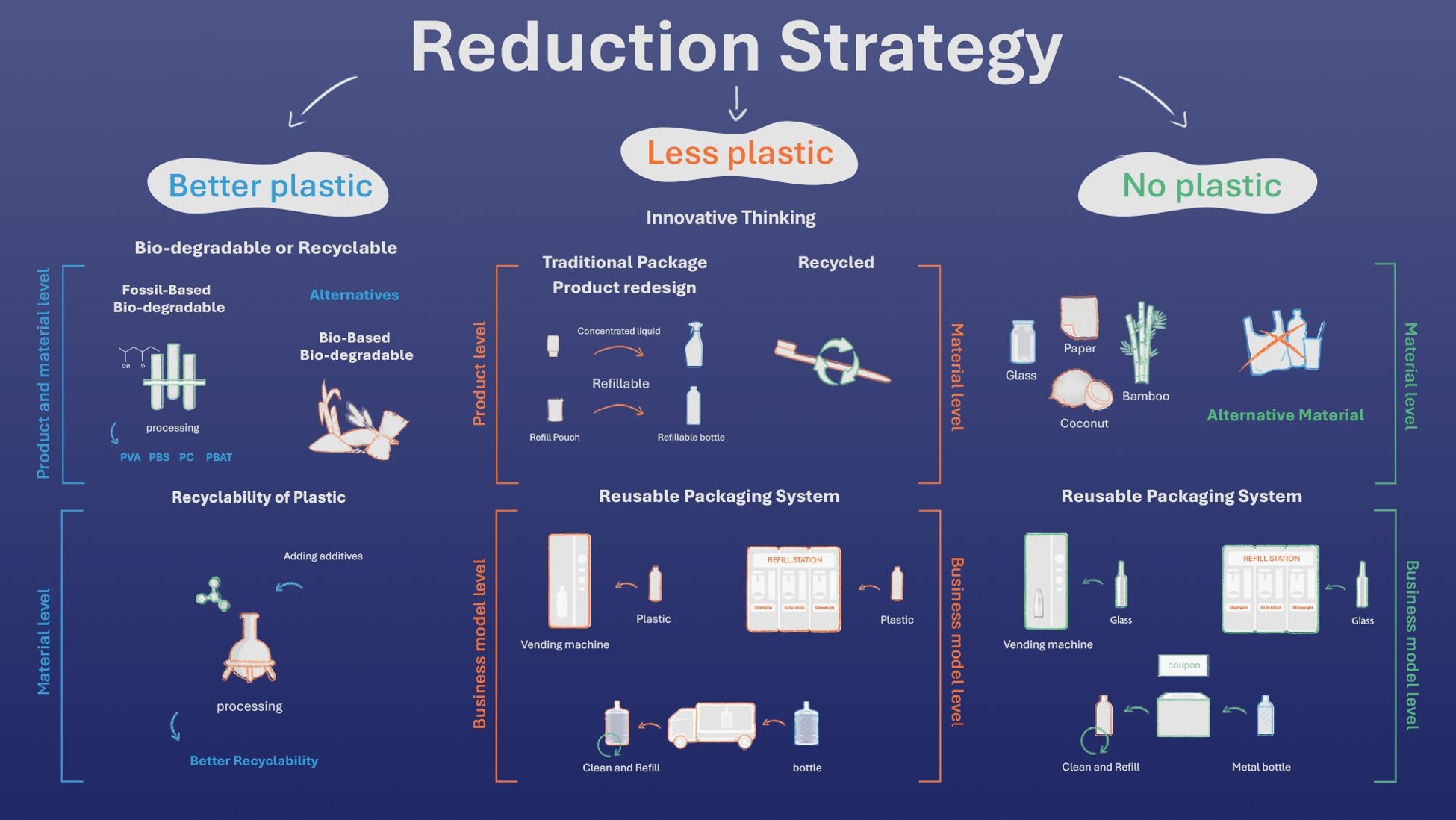
Better plastic means improving recyclability, or replacing fossil-based, non-biodegradable plastics with biodegradable materials that still do the job.
Less plastic means reuse and recycling: extending the life of the plastic already in circulation so we need less virgin material.
No plastic means switching to other materials, such as paper, cardboard, wood, or aluminum, where they genuinely fit.
No single strategy wins on its own. A biodegradable cup that depends on imported feedstock is not automatically better than a well-run refill system. The point is to match the strategy to the product, the waste stream, and whether people will actually use it.
When discussing the three strategies ("Better, Less, No"), can we include :
- Carbon footprint reduction.
- Waste diversion potential.
- Cost implications.
Where the work happens: four levers
Across those three strategies, the study identifies four levers where change is made.
Materials innovation is about what the product is made of: bioplastics, biodegradables, recycled PET and HDPE, and whether they hold up technically and economically in Egypt. This is where life-cycle assessment separates the genuinely greener option from the one that only sounds green.
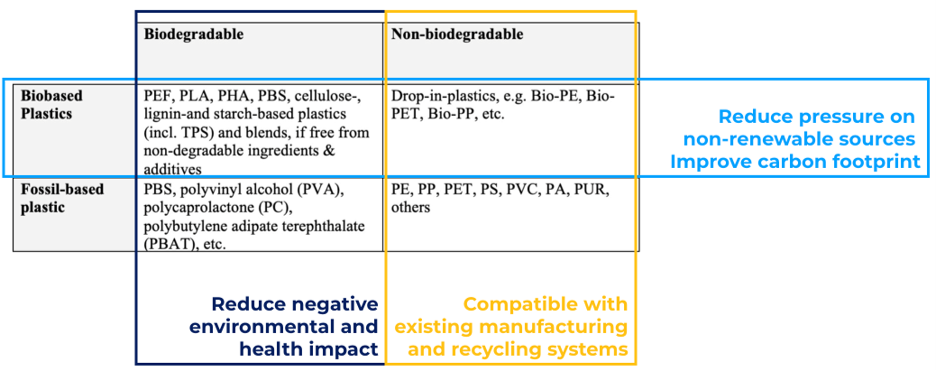
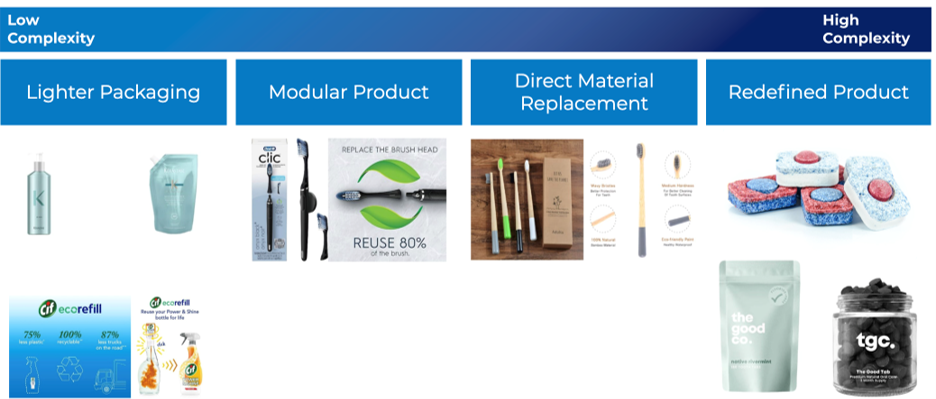
Product innovation is about using less material to do the same job: concentration, refill pouches, lightweighting. Some of these already deliver savings in Egypt today.
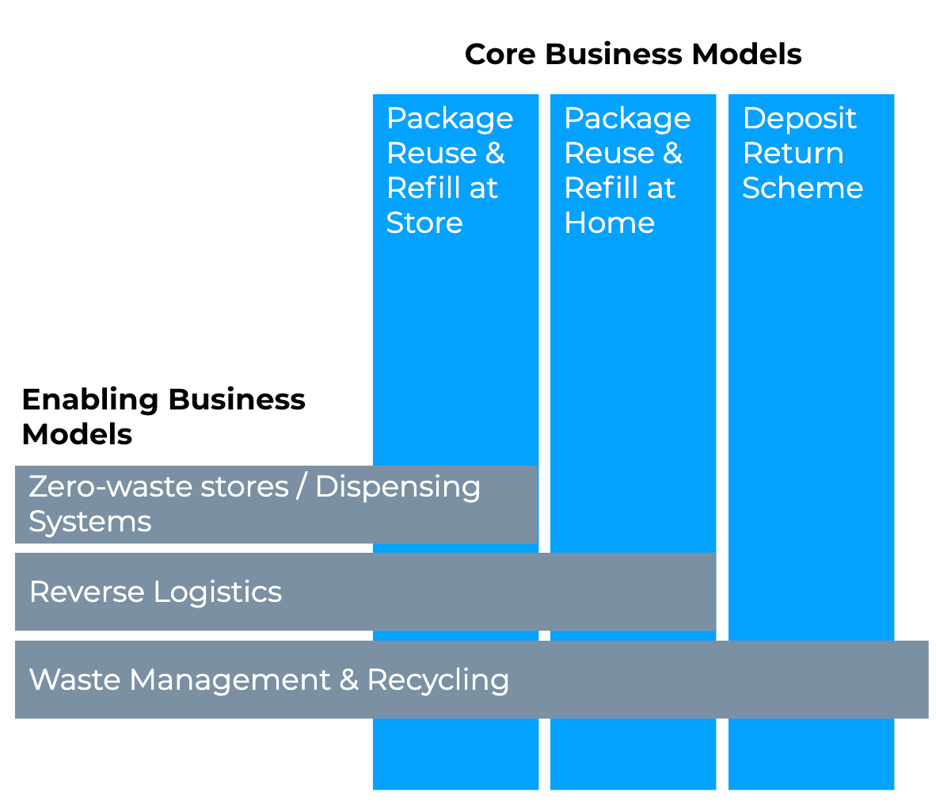
Business model innovation is about how products reach people and come back: refill and reuse systems, deposit-return schemes, reverse logistics. The technology usually exists. The hard part is making the model scale.
Policy and regulation set the rules that make the other three viable, from Extended Producer Responsibility to the design standards that decide what gets made in the first place.
Reducing single-use plastics in Egypt means working all four levers at once, matched to the realities of a market where the informal sector still handles more than 60 percent of recycled plastic production.
Two centers, two halves of the same problem
This is also why the study brought together two research centers at Nile University.
The Smart Engineering Systems Research Center (SESC) works on the materials and research half: testing which alternative materials actually perform, and running the life-cycle assessments that tell you whether a switch is a real environmental gain or just a marketing line.
The Innovation, Entrepreneurship and Competitiveness Center (IECC) works on the adoption half: how technology gets forecast, how products and business models get redesigned, and whether consumers will accept and pay for the result.
You need both. A material that works in a lab but that no one will buy is not a solution, and a clever business model built on a material that fails in the Egyptian heat is not one either.
What's next in this series
Over the coming weeks, we'll go a level deeper on each part of the map:
- Why "biodegradable" isn't a finish line, and what PLA and bioplastics really cost in Egypt.
- What the life-cycle numbers say about recycled PET and HDPE.
- What 122 Egyptians told us they will actually pay for.
- What a foresight exercise with industry revealed about where Egypt's plastics are headed by 2050.
- And finally, why materials science, consumer insight, and policy have to move together.
The headline figure, 5 million tonnes a year, is daunting. But it isn't a wall. It's a map, and there are more roads across it than the ban-it-all instinct suggests. The rest of this series walks them one at a time.
Acknowledgments
This series draws on a study made possible by many hands. We thank our co-authors Sherifa ElHady, ElHassan ElSabry, Amira Yassin, Sherif Hamed, Rana Adel, and Amir Azmy, and we are grateful to Asmaa Ahmed, Amr Hashim, Dina Tolba, Marwan Rashwan, and Salma Salah for their critical contributions. We also thank Asmaa Ahmed and Merna Hammad of Nile University, whose coordination and industry engagement were instrumental to the work.
We are grateful to Matthias Pfaff and Nahomi Nishio at UNIDO Headquarters, and to Eman Shaaban, Ahmed Ibrahim, and Abdulrahman Hag Elamin at the UNIDO Egypt office, for their guidance and for facilitating access to key data. Finally, we thank the Ministry of Environment and the industry leaders, policymakers, NGOs, and private-sector representatives who gave their time to the interviews and the validation workshop, and the Government of Japan, whose funding made the study possible.
About the authors
Ahmed Saleh is the Executive Director of the Innovation, Entrepreneurship and Competitiveness Center (IECC) at Nile University, where he works at the intersection of technology management, innovation, and entrepreneurship to strengthen industry competitiveness in Egypt and the region. An engineer by training, he has led innovation and venture-building programs, including work with Nile University's NilePreneurs initiative. He is currently a PhD candidate at Nile University's Graduate School of Management of Technology (MOT), where his research interests include technology commercialization in developing economies and digital transformation strategies.
Irene Samy Fahim is a Professor in the Industrial and Service Engineering and Management department at Nile University and Director of the Smart Engineering Systems Research Center (SESC). A Fulbright alumna, she holds a PhD in Mechanical Engineering from the American University in Cairo. Her research centers on sustainable materials, including bioplastics, natural-fiber-reinforced composites, and non-plastic single-use tableware made from sugarcane bagasse. She is a Senior Member of the IEEE and a recipient of the L'Oreal-UNESCO For Women in Science award (Egypt, 2021), the State Encouragement Award for Women (2020), and the Hazem Ezzat Research Excellence Award (2021).
Read the full study: Mapping Study of Alternatives to Single-Use Plastics: Reducing Single-Use Plastics in Egypt (UNIDO, 2025), commissioned under the project "Supporting the Promotion of Circular Economy Practices in the Single-Use Plastic Value Chain," with funding from the Government of Japan.
About the centers: The Innovation, Entrepreneurship and Competitiveness Center (IECC) and the Smart Engineering Systems Research Center (SESC) at Nile University.